
Egypt, Pakistan, Saudi Arabia and Turkey met in Islamabad in what analysts say is the formal opening of a new diplomatic formation that could reshape the post-war regional order. Their immediate goal is a ceasefire; their larger ambition is to ensure that neither Iran nor Israel emerges from this war in a dominant position. Pakistan's foreign minister then flew directly to Beijing and mooted a Chinese role as guarantor of any eventual agreement. Prem Panicker continues his must read daily blog on the Gulf War.
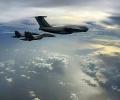
India has wrapped up its operation at a strategic air base in Tajikistan's Ayni following the lapse of a bilateral agreement, people familiar with the matter said this week.

The big question is whether Trump is any longer in command of the situation. For all practical purposes, the war seems set to cascade as the US is preparing for a potential ground operation in Iran and threatens to destroy 'bridges next, then electric power plants', points out Ambassador M K Bhadrakumar.

Trump may strike. He may announce productive talks and extend again. He may do both at the same time. Iran will not open the Strait on someone else's terms, so no matter what happens, that problem will remain unsolved. And the IRGC will still be collecting its $2 million toll from every ship bold enough to ask permission to pass.

For weeks, the war skirted the edge of catastrophe without tipping over. Missiles flew, there was much destruction, commanders were assassinated, cities across the Gulf and even in Israel struggled to absorb the shock. But one line held: Energy infrastructure, the arteries of the global economy, remained largely untouched. That is no longer true. Prem Panicker continues his must read daily blog on the Gulf War.

In the present hyper-connected world, there are many domestic and global factors that affect financial markets. Of them, the most powerful and often least predictable are geopolitical events, which often boil down to one diplomatic headline.

Taking Kharg would give the US control over virtually all of Iran's oil exports and thus provide significant leverage, notes Prem Panicker in his must read daily blog on the Gulf War. It would also put American troops within range of Iran's remaining missiles, drones, and artillery on a piece of real estate that is just eight square miles in size, and just 15 miles from the Iranian mainland.

The question is whether the clocks allow enough time for two deeply mistrustful sides to get there, and whether the surface calm holds long enough for the paddling to produce something before the ceasefire ends on April 22, notes Prem Panicker in his must read blog on the Iran War.

Two Indian ships carrying liquified petroleum gas (LPG) from the Gulf countries crossed the Strait of Hormuz early on Saturday morning, raising the number of Indian vessels safely passing through the war-hit, narrow shipping lane to three.

The LPG squeeze on India's restaurant sector is the quotidian face of a deeper crisis.

In the Indo-Pacific's new era -- where perception shapes reality faster than treaties -- the real entrapment is not of China or the United States. It is the test Japan has set for itself -- and whether partners like India, acting as balancers rather than accelerants, can help ensure that the story ends in stability, points out Varun Arya.

'The next two to three weeks will not be decided in Washington.' 'They will be decided in Tehran, in whatever calculation Iran makes about the costs of continued resistance against the costs of appearing to have yielded.'

The ceasefire is still technically holding, to the extent that no overt hostilities have been reported yet, but the rhetoric has hardened dangerously. The week ahead will also clarify whether the Islamabad failure was a negotiating tactic or whether Washington has genuinely locked itself into a position from which the only exits are climb-down, escalation, or the slow bleed of a new status quo that nobody chose and nobody controls. Prem Panicker continues his must read blog on the Iran War.

Russian President Vladimir Putin's visit to India this week aims to secure energy supplies, stabilise defence deliveries and ensure bilateral trade continues smoothly despite strong Western sanctions, GTRI said on Tuesday.

The core issues to be settled -- access to Hormuz, Israel's aggression in Lebanon, the question of Iran's nuclear programme, sanctions relief and compensation -- are thorny enough to require weeks of patient negotiation. The most likely outcome of the opening sessions is that both sides take the measure of each other, establish what is and is not negotiable, and return home without having broken anything. That would count as progress.

If Xi Jinping can establish control over the PLA Ground Force, relations between India and China will settle down to an even keel. The next few weeks will show whether Xi has finally succeeded in gaining control over the PLA Ground Force. That could bring about the substantive shift in India-China relations that both our leaders have been working for, observes Ambassador Prabhat Shukla.
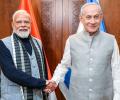
India and Israel share a deep historical bond, and Prime Minister Modi's visit to the Knesset marked a bold shift from past diplomatic hesitation to open strategic partnership.

India and Russia are poised to sign multiple agreements to bolster cooperation in various sectors, including trade and healthcare, during Russian President Vladimir Putin's visit to New Delhi. Discussions will also address the Ukraine conflict and efforts to increase Indian exports to Russia.

Alliances fight wars effectively only when they share an endgame. If Israel acted without US knowledge, then the military alliance is operating without real coordination at the level of strategic targeting. Neither picture is reassuring in a war that is no longer regional in its consequences. Prem Panicker continues his must read daily blog on the Gulf War.
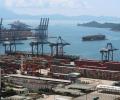
With the Iran war escalating sharply and crisis deepening in the global energy market, India on Monday unveiled a coordinated plan to support exporters and shippers caught in the fallout.

Israel and the United States had a plan. Iran punched back. And now the Gulf is reeling, the world is beginning to feel the pain and, as on date, no one in Washington or Tel Aviv appears willing to admit that the punch has landed, notes Prem Panicker, continuing his must-read blog on the war in the Middle East.

Iran launched retaliatory military strikes targeting Israel and American military bases across the region, including in Qatar, the United Arab Emirates, Kuwait, Bahrain and Jordan.
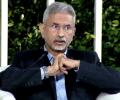
On President Putin's two-day trip to India, Jaishankar said for a "big" and "rising" country like India, it is important to maintain good cooperation with as many important players as possible in the world in line with freedom of choice.

For decades, the Siliguri Corridor was treated as a geographical vulnerability to be quietly managed. Today, it has emerged as a focal point of eastern geopolitics.

'The entire US ecosystem built over decades at the bases in the Gulf region, especially the UAE, costing trillions of dollars have been decimated, dealing a mortal blow to the US Central Command's war capability,' points out Ambassador M K Bhadrakumar.

Fight on toward goals that keep receding, or exit with most objectives unmet. Trump is agitated, his poll numbers falling below the Plimsoll line, his base fractured between those who back the war and those who remember that he campaigned on ending them.

The United States, which entered this war in expectation of a short, sharp win along the Venezuela model, is now preparing for deeper involvement in a conflict it does not fully control, without the allies it typically relies on, against an adversary that is not behaving as expected, in a global environment that is already absorbing economic shock. Prem Panicker continues his must read daily blog on the Gulf War.

Israel has for more than two decades and several US presidencies worked to draw the United States into a full-scale war with Iran. Having finally achieved that, the last thing it wants is Trump declaring victory and going home, as he is prone to do. Ali Larijani was the figure most capable of handing Trump a negotiated exit with something to show for it. Without Larijani, the road to an exit gets considerably narrower. Prem Panicker continues his must read daily blog on the Gulf War.
India and the US have entered a new phase in their relationship, marked by greater parity, point out Harsh V Pant and Vivek Mishra.

'India is at a critical juncture in this century. I want to be a part of the diplomatic team that works to make India great.'

'TTP has vowed to take revenge for the attacks that Pakistan is carrying out against Afghanistan.' 'To diminish this threat, Pakistan is hitting Afghanistan hard.'

Pakistan launched a retaliatory operation, 'Ghazab lil Haq,' against the Afghan Taliban following alleged border attacks, resulting in reported casualties and destruction of Taliban infrastructure.

Pakistan declared an 'open war' with Afghanistan following airstrikes targeting Taliban fighters in response to alleged cross-border attacks. The situation has drawn international concern, with calls for de-escalation and diplomatic resolution.
The recently signed Gaza Peace Agreement is a 'landmark' step towards stability in the Middle East, India has said, reiterating that a two-state solution remains 'the only pragmatic path' to achieving durable peace between Israel and Palestine.

Indian security agencies have continued efforts to reinforce the Siliguri Corridor through improved infrastructure, faster mobilisation capability and diversified connectivity routes to the north east.

'Should China's interest in the Teesta River projects be approved, it would likely result in heightened Chinese presence near the Siliguri corridor.'

As the controversy erupted surrounding the removal of Bangladesh fast bowler Mustafizur Rahman from the Kolkata Knight Riders squad, Congress leader Adhir Ranjan Chowdhury questioned whether this action would improve the security of Hindus in Bangladesh.

When everyone has footage and no one can verify it, the loudest voice wins, notes Prem Panicker who begins a daily blog on the War in the Middle East.

Zelenskyy, in a social media post, said Ukraine appreciates India's dedication to "peace and dialogue".

'The BNP's election manifesto lists grievances against India, mirroring the attitude of past BNP governments.' 'Political parties have been careful not to say bad things about China.'
